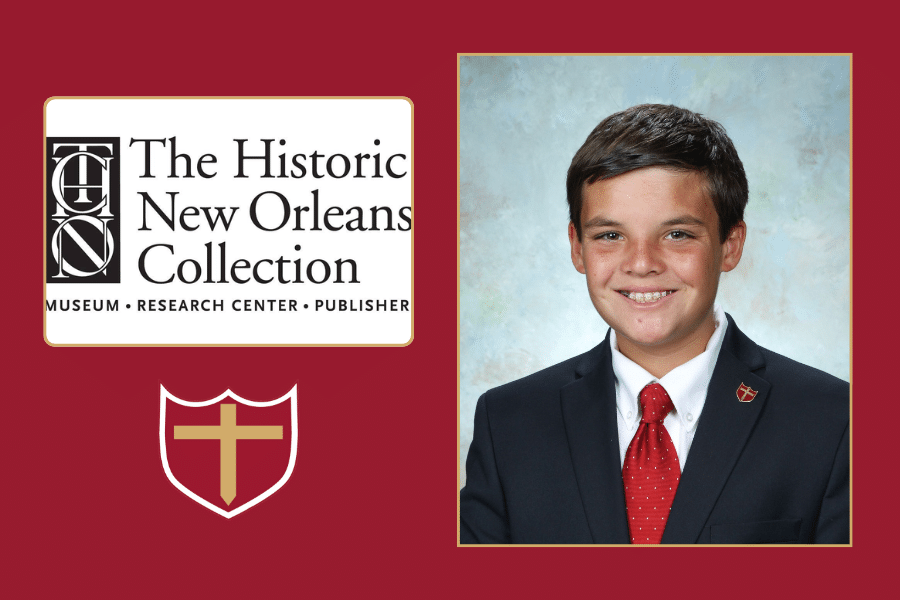
We are pleased to announce that Brother Martin 8th grade student, Braden Fox '29, has received an Honorable Mention for his essay entitled “The Stories and Cultures of The Melting Pot,” which he submitted to The Historic New Orleans Collection during their Making It Home: From Vietnam to New Orleans exhibition.
"In conjunction with the exhibition Making It Home: From Vietnam to New Orleans, HNOC’s 2025 Student Writing Contest asked elementary, middle, and high school students to reflect on forced migrations—past, present, or imagined. More than 500 student writers from across Louisiana and beyond responded, drawing on their own family stories, current events, and historical knowledge in essays that are imaginative, rich, and moving. The winning authors will receive cash prizes as well as have their essays published online. Congratulations to the winners and thank you to all who participated!"
“The Stories and Cultures of the Melting Pot”
by Braden Fox '29
Imagine you are having a quiet night with your family, a zephyr rustling throughout the trees when you hear a knock on your front door. You check, and a man dressed in a British military uniform stands there awaiting you. You are forced to swear allegiance to England. You tell him your allegiance is conditional, since your family immigrated from France, and you would never swear allegiance to someone who would hurt your family or friends. As a result, your family is brought out by force and told to gather your possessions to prepare to be shipped out tomorrow morning. Upon boarding a ship, you are assigned to your quarters, a small area packed with dozens of friends and acquaintances. Hundreds of you boarded the ship, and conditions are harsh. Rations are sparse, providing barely enough nutrients to survive, with dozens of passengers dying on the voyage. Eventually, after what feels like decades, the ship reaches its destination: a desolate swampland filled with terrifying creatures. However, you and your group of refugees settle down and create a thriving civilization on Louisiana’s bayous.
In the late 1750s, the British, engaged in the French and Indian War, evicted the Acadians from Nova Scotia for refusing to pledge allegiance to England. The Acadians initially had nowhere to go, but they survived by reaching the East Coast, the Caribbean, and especially the swamps of Louisiana. One of my distant relatives was among the first French immigrants from France to Nova Scotia. A century later, her descendants were some of the first Acadians forced out. Despite enduring immeasurable hardship, they persevered to create a better life for their children, allowing me to be here today.
During the Acadian Diaspora, they were limited to few to no possessions. Due to the crowded boats, many were forced to leave excess possessions onshore. However, physical possessions did not define the Acadians; their culture did. They carried their stories with them, passing them down from generation to generation so that I could write about them today. Acadian culture was multifaceted, spanning dialect, food, religion, and more. The Cajun dialect brought by the Acadians is an iconic part of New Orleans life. Additionally, the food they brought is a staple of New Orleans culture, which is what comes to mind when most people think of New Orleans food. Gumbo, etouffee, and jambalaya are valuable parts of our culture that would not exist without the Acadian influence. Furthermore, the religion and values of our city are also heavily formed by the Acadians. Due to their French heritage, the Acadians were largely Catholic and held strong familial values; as a result, after traveling to New Orleans, they instilled those beliefs into their children, leading to New Orleans being one of America’s most Catholic cities.
Like the Acadians, the Vietnamese fled their home due to war. Before the fall of Saigon, millions of Vietnamese were forced to evacuate or face the wrath of North Vietnam’s communist party. Like the Acadians, many Vietnamese sought refuge in America, with many finding asylum in New Orleans, carrying only the clothes on their backs, a few documents, and family photos to remind them of those they lost along the way.
The Vietnamese immigrants faced numerous tribulations. Rough seas, pirates, a lack of food, and the stress of leaving home behind forced many to suffer immense tragedies. Despite the duress, these Vietnamese immigrants built a home for themselves here, establishing themselves as a fundamental part of New Orleans culture by telling their tales and sharing their stories.
Upon arrival in New Orleans, the Vietnamese shared their culture, adding flavor to the melting pot. Fitting the melting pot analogy, the Vietnamese brought their cuisine, which quickly integrated into New Orleans’s culinary scene. From delicious pho to Dong Phuong’s twist on a New Orleans classic, the Vietnamese found a niche in New Orleans cuisine. Additionally, the Vietnamese tradition has adapted multiple festivities into New Orleans culture. The Festivals of Tet and Mid-Autumn are two notable celebrations now celebrated in our city, proving how these diasporic Vietnamese have made a name for themselves in New Orleans society.
Forced migration is a terrible fate for anyone. It is heartbreaking to leave your life behind and lose your family, friends, and home. However, forced migration is not entirely bleak; New Orleans’s Cajun culture thrives because of the Great Upheaval. Similarly, thanks to Vietnamese immigration to New Orleans, we can now appreciate the rich cultures and traditions that have become another ingredient in New Orleans’s melting pot.
