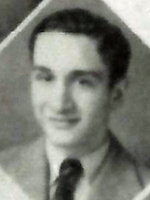
Philip Ciaccio ('43)
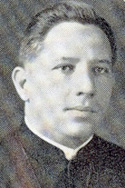
Brother Martin, S.C.

Brother Roger, S.C.
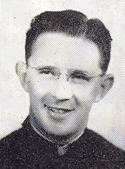
Brother Gregory, S.C.
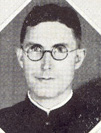
Brother Frederick, S.C.
|
Political Calling - I
Judge Philip Ciaccio ('43) fondly recalls the excellent instruction he received from the Brothers at St. Aloysius.
- His family lived only three blocks from the school at 1322 Esplanade Avenue. After he attended St. Augustine School through fourth grade, his mother decided to send him to St. Aloysius. She went to see Brother Martin, the principal, and told him the family couldn't afford the $15/month tuition. He told her to send her son anyway.
- The elementary school classes met in a separate building, a two-story wooden structure on Esplanade.
Aloysius was in its prime. The big school yard was dirt, not paved. One day, the Honorable Mayor Maestri sent over his crew, and they blacktopped the yard for us. We could play tennis and volleyball. The brothers conducted skating parties on Saturday night. Boys and girls. Brother Roger was in charge. He was also our tennis coach although I don't think he ever played tennis.
- When he finished 7th grade, Philip moved to the main building for his freshman year, there being no 8th grade at the time.
I was an exemplary student. It was the biggest tragedy of my life to have anything less than an A.
- Students stayed in their homerooms all day with the teachers coming to them. His freshman homeroom teacher was Brother Mark.
We thought he was an old guy, but he was just a few years older than me!
- Every one of Philip's classroom teachers was a brother. The only laymen on the faculty were Henry "Wop" Glover, the football coach who taught Physical Education and Professor Joseph Taverna, the band director.
- Like countless alumni, Philip recalls Brother Gregory for his excellent math teaching.
Almost everything they taught us the first semester at Tulane, I had already learned at St. Aloysius. Our math teacher was an ex-football coach. We knew more than he did.
- He received his only B in Brother Frederick's Physics class. As a result, he finished second in his graduating class.
He was brilliant and a wonderful guy but in another world. He was the only teacher I had like that. When I came home with a B, it was a tragedy in the family.
- He greatly admired Brother Martin.
He was dearly loved and feared. I can remember we had this nice new gymnasium. The student body would gather with everybody talking. Brother Martin walked in and raised his hand. Everybody shut up. If someone said a word, he motioned for him to come down here. A very fair man. The thing that astounded me was when I ran into him years later when my kids graduated from high school, I'd go up to him and shake hands. "I know you, Philip. How are you doing?" How could he remember me after all those years?
|
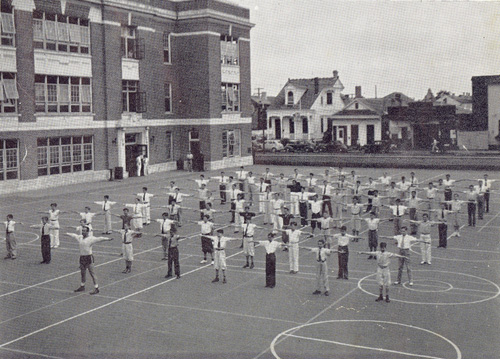
Coach Wop Glover leading a PE class in 1938-9 on the blacktop provided by Mayor Maestri
After graduating a few months short of his 16th birthday, Philip started at Tulane on a scholarship.
- One of Philip's uncles was the precinct captain. Everyone voted the way uncle said. Philip's father extracted a promise from the Old Regulars that they would give his son a scholarship to Tulane. But after one semester, they gave the scholarship to someone else.
- Fortunately, his father's meat market/grocery was prospering so that he could afford the $250/semester tuition. After a few years of riding the streetcar uptown, Philip drove a Model A Ford that his dad bought for $150.
- Philip enrolled in a premed curriculum because his parents and grandparents wanted a doctor in the family. But he soon realized that he didn't want to be a doctor. When I told them I was quitting, they almost died.
- He completed his degree just as World War II ended and entered Tulane Law School. He graduated in 1950 and got his license in civil law.
- He was working for a law firm when the Korean War broke out. With the draft reinstated, he joined the National Guard. But training once a week while others his age went to Korea really bothered him.
- So he called his future father-in-law who contacted Congressman F. Edward Hebert to arrange a commission as a First Lieutenant in the Air Force as a legal officer.
He was stationed in Fort Worth TX.
- His main problem was separation from his intended, Mary Jane Bologna.
I'm madly in love. They let you off for the weekends. So I drove home in my little Studebaker Champion. I'm going off the road half-asleep. I told her, "Either we get married or I'm going to be dead."
- So they married at St. Louis Cathedral and moved into an apartment on the base. He received $325/month plus housing. I'm rich! he thought.
- After a stint at the staff school in Montgomery AL for several months, he and his bride returned to Fort Worth.
- Then came a new challenge - assignment as the legal officer at a base in North Africa. He could bring his wife with him only if he agreed to stay two years, one year otherwise. He chose the latter. At least it wasn't Korea.
- So they drove to New Jersey where he would board a troop ship for the trans-Atlantic crossing.
She had just gotten pregnant and threw up from Birmingham on. I took her to a doctor in New Jersey because she was dehydrated. She flew back to New Orleans by herself - her first time on a plane.
- He missed the birth of his first child, Kathleen, while in Africa. He would be present for the other ninth births.
When Philip completed his enlistment with the Air Force, the young family settled down in New Orleans.
- He resumed his civil practice with a friend from Tulane, Al Cronvich, who would become Sheriff of Jefferson Parish.
When I got out of the service, Al gave me a desk to sit at and cases to handle until I got on my feet financially. The practice built up quickly and we became partners. Ultimately we both got into politics.
To be continued ...
|
