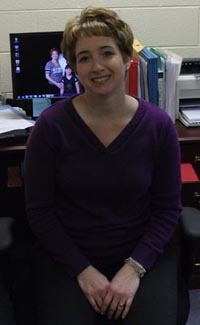
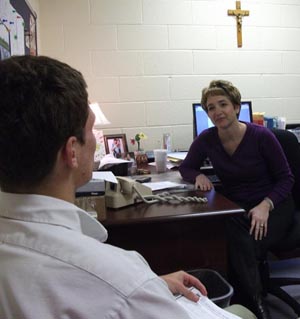
Jill Gomez started as a math teacher before becoming a guidance counselor.
- A graduate of Mount Carmel, she earned a bachelor's degree in Math Education and a master's in Counselor Education at UNO.
- After teaching at John Curtis for a year, she joined the faculty at De La Salle where she eventually became Math Department Chair.
- When she completed her graduate degree, she took a full-time counseling position at Brother Martin 15 years ago.
- She moved up to head of the Guidance Department in 2004-5 .
- She prefers the all-boys environment to the coeducation she experienced at De La Salle.
There's no sense asking Jill if she misses teaching math because she still teaches it.
- She teaches the Math/Science part of ACT Prep on Sundays throughout the school year and even in the summer.
- She also teaches math in the June Enrichment Program for incoming students.
- Boys who had her for ACT or Enrichment regularly visit her office for guidance - in math.
- She also taught an Algebra I class in 2005 at the night school in Baton Rouge.
She has seen many changes in guidance services during her tenure at Brother Martin.
- The staff spends much more time in personal counseling, which includes helping students, particularly the younger ones, get organized and develop study skills.
- Counselors have become more involved in the scheduling process with the teachers. They look at much more data from grades and standardized tests to help place students in the proper courses.
- The assignment of counselors to grade levels has changed. Instead of a counselor taking, say, the 9th graders every year, counselors stay with an age group for several years. Currently Brother Carl has the 7th graders (the smallest group) and either the 8th or 9th graders depending on the year. Another counselor takes the students at 10th grade and stays with them through 12th before picking up a new group of sophomores.
Because we have them several years, we get to know families. We're also having repeat families with younger brothers.
Students have changed in significant ways.
With technology and the way they're brought up, they don't think linearly the way I do. There are some traditional skills we learned as students that we took for granted, such as research skills, that many students don't have now. They're still important even though they now have a computer. They don't have the same skill set students used to have. And I don't see the same work ethic.
Counselors also work with parents differently.
We spend a lot of time helping and educating parents. Parents often aren't comfortable with our decisions concerning the student's courses. Some are less comfortable with the idea that sometimes kids have to fail. We struggle with getting some parents to understand that that's a normal part of the process of growing up.
What I see is kids not growing up as quickly responsibility-wise. Parents are intervening more often at an older age. 8th-10th grade is usually when we have to sort all that out.
There was a trend for a while of not wanting to hurt the boy's self-esteem. We try to be realistic with the student. This is what you did wrong; this is how we'll help you fix it. That builds self-esteem. Sometimes they need to make a mistake and take the consequences that come with it.