 |
CRIMSON SHIELD THE ONLINE MAGAZINE OF BROTHER MARTIN HIGH SCHOOL |
|
| December 2011 Published Monthly September through May |
||
A Chat with the President - II
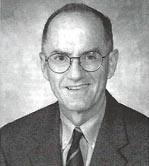 John Devlin in 2005 |
"I had a sense something big was going to happen a couple of days before."
He and Paula evacuated Tuesday in Times Picayune trucks with 150 other people.
|
The Brother Martin administration convened at Catholic High in Baton Rouge to figure out what to do.
- Principal Gene Tullier broached the idea of establishing a night school on Catholic High's campus. He brainstormed with Brother Francis David, CHS President, and Brother Barry Landry, CHS Principal, to work out the details.
- Brother Barry moved his schedule up 30 minutes so that Brother Martin of Baton Rouge could begin at 3:45 and continue to 9:45 Sunday through Thursday each week.
- Catholic High had just vacated two portable classrooms that were made available as faculty space for Brother Martin. Many of the evening classes met in the brand new Brother Gordian Science Building along with rooms in the main building.
If you create a night school, will they come?
- Both the parents of Brother Martin students as well as faculty members assumed that the administration would gather at Catholic High. So by the second week after the storm, students began signing up, and faculty members came to Baton Rouge to help organize the new school. Others phoned to express interest in teaching at the night school.
So many faculty contacted us. They wanted their job back, but it was more than that. "I'll move there. I want to be part of this. If you don't need me in Baton Rouge, you can use me in New Orleans." Some commuted to Baton Rouge when they could have taught here. They wanted to be with our kids and knew our kids needed to see them. Our kids needed that stability, familiar faces.
- As quickly as possible, the school website was transferred to a new server and became an important means of communicating with parents, teachers, and students.
- In response to inquiries, it was decided to accept boys displaced from other New Orleans schools. "Then Cindy Thomas [President of Dominican High School] called. 'John we can't do what you're doing there. Would you consider girls?' Gene and I had had that conversation." So they readily agreed. "One of the prize possessions those girls [who attended the night school] have is a Brother Martin ID card."
- Approximately 450 students began classes. A significant number left as their families moved back to the New Orleans area and the Rummel Transitional School opened. However, as the semester proceeded, almost as many new students started classes in Baton Rouge, some as late as early December.

Gene Tuller (center) presents Brother Barry (left) and Brother Francis (right)
a montage of pictures from Brother Martin in Baton Rouge in December 2005.
With plans for BMBR in motion, John turned his attention to the Elysian Fields campus.
- John recalls standing on St. Aloysius Drive with Brother Ivy, the Provincial of the New Orleans Province, Gene Tullier, and Nick Lagatutta as they contemplated the task ahead that September. "It didn't take us a nanosecond. We said, 'Yes, we can do this.' We never had a thought of not reopening. Not if, but when. That's how we all approached it."
- The Board of Directors set January 17 as the target date for reopening in New Orleans even if the school had to operate on the second floor of the main building.
- The Board also made the formal decision to declare that a state of financial exigency existed. That meant that the clause in every employee's contract that allowed cancellation of the contract in the event of an emergency went in effect.
- The Board decided to continue to pay health insurance for all faculty and staff members, even though they had no idea where some of them were.
- Priority was given to hiring existing faculty members for the school in Baton Rouge. Others who could not make it to Baton Rouge or were not needed there would be hired to help clean up on Elysian Fields. The latter group performed tasks that needed some educational experience, such as inspecting every book in library to see what could be salvaged, saving what could be saved in the first floor faculty rooms, clearing student lockers, and so on.
- "Whatever their contract was before the storm, that's the rate at which we hired them for the remainder of the semester. We tried, as Brother Martin himself would have been adamant about, to take care of our people. We lost some good folks who left and got great jobs elsewhere."
- "We started getting questions immediately [after the storm] about tuition. Families that paid semi-annually, annually, or quarterly had already spent a chunk of money. Because we had the St. Aloysius Century Foundation as a backup, we were able to refund those who couldn't attend the school in Baton Rouge."
John recalls attending the first post-Katrina meeting of school leaders.
- Father William Maestri (CJ '66), the acting Archdiocesan School Superintendent, asked how the schools were handling tuition refunds.
- "Some said, 'We haven't gotten to that yet.' Some said they didn't know where their financial books were. One school announced it would not refund any tuition. When it was my turn, I said, 'Father, about 10 a.m. this morning, we put the first 150 refund checks in the mail.' You could have heard a pin drop in the room."
- "We processed several hundred thousand dollars worth of tuition refunds in the month of September. We let students come [to Baton Rouge] even if they couldn't pay. If families hadn't gotten refunds, pay when you get it. Every student was an individual case. I kept thinking, 'What's in our charism? What would Brother Martin want?'"
- Did the good will generated in the months after Katrina stand the school in good stead in the years to come? "Absolutely. What we did spoke the world to our grads and parents and students about what we really stand for: personal attention as part of the charism. We're reliable. You knew we were going to be there. We said we'd reopen in January and we did."
- "We also created good will in the neighborhood. Right after we gutted the building in the third week of September, an elderly couple walked in. They had just seen their house. 'Are you all rebuilding?' 'Yes, we are. We're planning to reopen in January.' 'If you weren't going to rebuild, we weren't going to rebuild.' Brother Martin coming back gave permission for neighbors to say, 'It's not all over. We'll rebuild too.'"
 Trash in front of school |
 Water outside Physics Lab |
Priorities had to be established for refurbishing the Elysian Fields campus.
- Ryan Gootee, the contractor who had been working on the Meyer Building, was hired to refurbish the main classroom building. Some "finishing touches" would be postponed. "My office was in the Development Building until April. It had only a small amount of water and was ready to go before everything else."
- John told the contractor to concentrate on getting the first floor classrooms ready. When students arrived in January, administrators were working on tables in hallways. The library was not ready until school ended in May.
- Since the first floor had to be refurbished, some ideas that were scheduled to be implemented in Phase 3 of the building program were built into the redesign. For example, each set of four classrooms off the downstairs Resource Center were turned into three. The Business Office and administration area was redesigned.
- John and Paula moved into an apartment in the French Quarter the second week of October. They still live there.
|
When December came, John had an idea for a fitting way to mark the closing of the school in Baton Rouge.
|
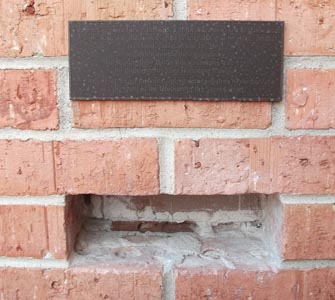 The missing brick next to the main entrance of Brother Martin with a plaque explaining where it has been relocated. |