|
Political Calling - II
After Philip Ciaccio ('43) built up his law practice, he decided to enter politics.
- He ran for the state legislature in 1959 on the ticket of Jimmie Davis, a "moderate individual" who was running for governor after serving from 1944-48.
My whole family got involved, knocking on doors for a year. In the first primary, I was way ahead. Then Davis became a segregationist. I'm running in the 9th Ward, Gentilly Woods, the Desire Project, areas with a high black population. I had represented a lot of black pastors. I lost by 225 votes out of 25,000. My mother cried for several months. But I learned a lot. People who supposedly support you are working for the other side. I was a novice, but I learned and became pretty good at it. There are no Marquess of Queensbury rules in politics.
- Philip tried again when Adrian Duplantier ran for mayor after "Chep" Morrison ended his 15-year tenure in that office. But again Ciaccio got caught in the crossfire. Victor Schiro, who had been appointed to fill out Morrison's term, learned the Jimmie Davis lesson and became a segregationist. Philip and his friend Maurice "Moon" Landrieu led in the first primary for the City Council but lost in the runoff.
- But after defeating Philip for City Council, the man who bested him for the legislature gave up that seat. Ciaccio decided not to run for that seat again, in large measure because he couldn't afford the $250 entry fee. But the leaders of the Seafarers Union persuaded him to enter the race because Schiro had campaigned against labor unions.
Every elected official in the city of New Orleans endorsed my opponent, including the governor whose ticket I had run on. But I had built up an army of individuals. The other side spent $25,000. I spent $500 in the first primary, and I'm way ahead. This time, things finally changed.
I had a meeting with Vic Schiro at the airport when he came back from South America. I brought my brother-in-law with me. He brought a gun. He's from the same town in Sicily where we're all from. Vic told me, "I'm going to pull my endorsement of your opponent." A gentleman whose name I won't mention was a prime segregationist who backed my opponent. "I can't let that pipsqueak do this to you. I want you to crush him." The opposition spent at least $50,000. That's like $200,000 today. I got my people knocking on doors, unions on the telephone. To everyone's utter amazement, I won. Then I defeated the Republican in the general election.
After all this, Vic calls me in. "I'd like you to be one of my floor leaders in Baton Rouge." I wasn't mad at Vic. I liked Vic. So I agreed. Politics makes strange bedfellows.
- Ciaccio spent two years in the legislature while John McKeithen was governor.
He wanted the Constitution changed so he could run for a second term. I was friendly with labor; they had elected me. But I was not their captive. Labor leaders came to me. "Are you going to support the Constitutional amendment?" "I don't know." After awhile, I get a call that the governor wants to see me. So I go to his office. "Rep, are you going to support this amendment?" I replied, "Let me ask you a question. Do you want me to vote for it?" He reared back. "Yes." "That's all I want to hear. You want me to vote for it, I'm for it. Don't send those flunkies down there to ask me to vote."
- When the same seat on the City Council came up for election the next time, Schiro asked Philip to run for it. Happy in his position in Baton Rouge, Philip turned down the mayor. But Schiro's opponent, Jimmy Fitzmorris, persuaded Ciaccio to run for the position on his ticket. Fitzmorris lost, but Ciaccio won as did Landrieu.
We turned out to be Schiro's two best friends on the council to get things done. I'd go into see the mayor to get someone on a board. "He was against me when I ran for mayor." "I'm not asking you to do it for him; I'm asking you to do it for me." "For you I'll do it." He never turned me down. Vic was a good guy who did a lot of good for the city and never got the credit he deserved. Morrison was a tough act to follow.
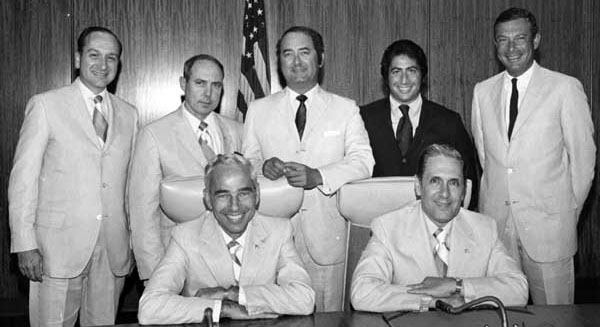
New Orleans City Council 1970; Philip Ciaccio is standing at the far left.
- Philip was reelected to the council in the first primary three times. During that time, he helped his friend Landrieu win the mayorship.
I was his best friend on the council. When the Ninth Ward needed improvements, I got preferential treatment. Moon knew how to get along with the seven councilmen who were all male and all white. The first black councilman came on when Eddie Sapir left to become Traffic Court Judge. We appointed the Reverend A. L. Davis to complete the term - a very nice guy.
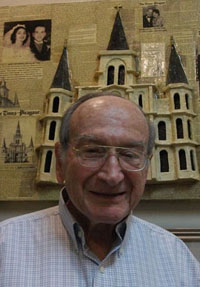
Judge Ciaccio in front of a wedding anniversary display in his home in Lakeview.
|
- The last mayor Ciaccio worked with as councilman was Ernest "Dutch" Morial, the first Africa-American to hold the office.
I had a cordial relationship with Dutch, which was unusual because he was hard to get along with. He and Councilman Joe Giarrusso constantly tangled. I'd go into the mayor's office to make peace. Dutch says, "Philip, you don't understand. I enjoy confrontational politics." "You mean I'm busting my guts making peace and you're enjoying the fighting?" But he was a very good administrator. If you didn't do your job, he fired you. I became his spokesman on the council.
- In 1982, Philip won election to a ten-year term on the Fourth Circuit Court of Appeals
It was perfect for me. My law practice had diminished because I was so busy. I got everyone supporting me for the judgeship. Only one person qualified against me but he stayed in about two weeks. So I went in unopposed for the first time.
- Ciaccio was reelected in 1992 but had to retire when he reached 70. But he kept busy for many more years with temporary appointments to serve on cases where a judge had to be recused. When asked what was his most interesting case, he replied:
I found them all very interesting. To this day, I could get into the most mundane case, and it was interesting to me. Unless you enjoy reading and writing, you don't want to be on the Court of Appeals. But you're like a hermit. I was ready for that after being on the Council for 16 years with people calling me and complaining. It was like I died and went to heaven.
Three of Judge Ciaccio's sons graduated from Brother Martin along with four grandsons.
|
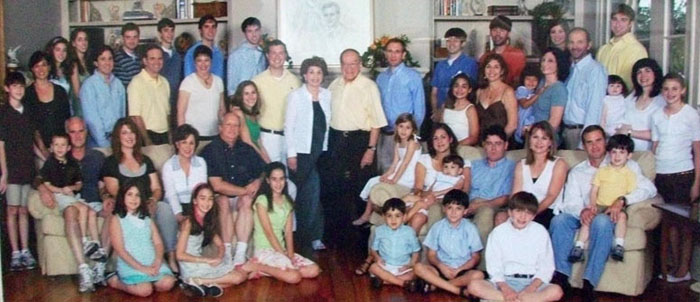
Philip and Mary Jane Ciaccio and their progeny |
|
