 |
CRIMSON SHIELD
THE ONLINE MAGAZINE OF BROTHER MARTIN HIGH SCHOOL |
|
| November 2010 |
‹‹ Front page Next article ››
In 2000, a team of archaeologists deep in a rain forest in northern Guatemala uncovered the remains of an enormous Mayan palace built over 1,200 years ago. Leader of the team was Dr. Arthur Demarest ('70), a professor at Vanderbilt University.
- Having declared his intention at the tender age of four to become an archaeologist, Arthur studied MesoAmerican anthropology and archeaology as an undergraduate at Tulane.
- He earned a doctorate at Harvard.
- In 1984, he began teaching at Vanderbilt where he holds the endowed chair of Ingram Professor of Anthropology and heads the Institute of Mesoamerican Archaeology.
Demarest began working in Mesoamerica 25 years ago.
- The discovery of the palace in the region of Cancuen was not his first major find but ranks as the most important.
- Ten years later, the "dig" continues to produce discoveries that have led to a new hypothesis about the decline and fall of Mayan civilization.
Arthur was written or co-written a number of books and articles such as Ancient Maya: the rise and fall of a rainforest civilization and Viracocha: the nature and antiquity of the Andean High God. National Geographic produced a movie about his work that generated more than $300,000 in funding.
|
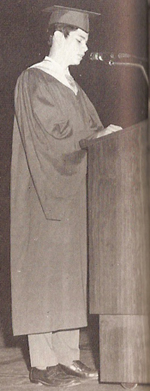
Arthur Demarest giving the 1970 Salutatorian address |
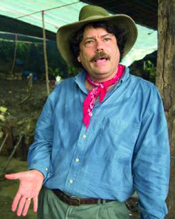
Dr. Arthur Demarest |
The media has portrayed
Arthur as a "modern-day Indiana Jones." His adventures include a period when he received death threats.
- The danger came about in 2003 when a local villager was severely beaten by drug traffickers searching for a valuable altar stone that had been looted from the Cancuen palace.
- Demarest joined forces with Guatemalan law enforcement to recover the altar, paying out of his own pocket for helicopters, boats, and lawyers to facilitate the investigation.
- Officials eventually recovered the monument and convicted the looters.
- Demarest and others who testified against them faced death threats, forcing him to hire bodyguards. Armed gunmen fired on the dig site.
As a result of these and other experiences, Demarest heads a movement he calls "ethical archaeology" which he defines as "using the archaeology and the publicity it generates to help the improverished people near the sites." Because of his efforts to develop the regions around his digs, Arthur received the National Order of Cultural Patrimony from the Guatemalan government in 2004, the first U.S. citizen to be so honored.
|
Demarest has employed advanced scientific methods such as DNA analysis, instrumental neutron activation analysis, laser ablation, and inductively coupled plasma mass spectrometry to determine what types of activities took place at the site. "My digs are more technological than anybody's," he boasts. Yet he refuses to write using a computer or even a typewriter. (He must have had a lousy computer science teacher.)
Arthur is a controversial figure in Mayan archaeology.
- One of his friends, David Freidel of Washington University, calls him "the most important archaeologist working in Guatemala today" not only because of his research but also because of his collaborations with the Guatemalans to improve their living conditions.
- Critics think that he has a genius for self-promotion. Freidel counters that Arthur publicizes his successes in order to raise money for both his archaeological and community development projects.
We'll conclude with a quote from Arthur that ended the August 2010 Cosmos article on him: "I intend to keep digging until I'm dead."
Return to top |
|