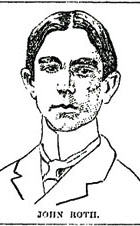
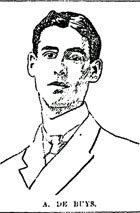
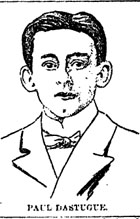
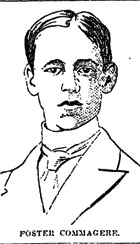
An July 1, 1899, article in the Times-Picayune on the St. Aloysius Commencement was accompanied by drawings of four of the graduates. The drawings provide the oldest known renditions of St. Aloysius students.
St. Aloysius Holds Its Commencement.
A Large Crowd Gathering at the Grand Opera House
And Enjoying an Excellent Programme of Exercises.
Diplomas Awarded to Four Graduating Class Members,
With Medals and Premiums for the Leaders in the School's Other Classes.
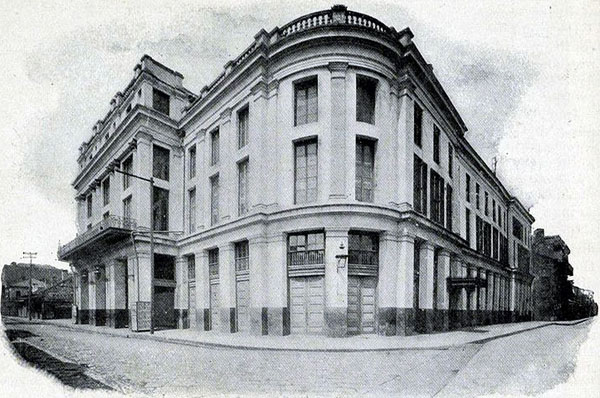
The Grand Opera House was crowded last night on the occasion of the closing exercises of the St. Aloysius Commercial Institute, located at the corner of Esplanade and Rampart streets. The exercises were most pleasing and interesting to the large audience and the applause was frequent and well deserved. A very fine programme had been arranged, which brought forth the talent of the young men in histrionics, declamation, and recitation. The cantata, "Old Glory," was the opening number, the boys who took part wearing badges of the national colors. The leader was Master M. Lagarde, while Peter the Hero was impersonated by Master J. Arnoult. The following young men were cast for the parts of Sons of Liberty: L. Bermudez, D. Fatjo, A. Garsaud, H. Preau, Jas. Brown, E. Vernay, E. Theard, H. de Monsabert, W. O'Connell, L. Hughes, W. Conquille, R. Lacoste, P. Braud, H. Trepagnier, E. Wiltz.
The "German Regiment" followed, with Masters L. Sassinet as the major, A. Zitzman as Haus and Masters F. Venneman, M. Dufour, E. Jacquet, V. Avegno, R. Trepagnier, A. Zitzmann, G. Moreno, C. Hauer, L. Peyrounin, L. Sassinet, J. Sambola, L. Cucullu, C. Coquet and G. DeBuys soldiers. Master F. Carriere played the part of General Putnam and A. Moreno that of Colonel Smithen. The first part closed with the chorus "Let Old Glory Wave," by the boys.
The Fourth of July dialogue, by Masters C. Sheen, D. Fatjo, A. Zitzmann, J. Gauthreaux and H. Herrmann, was very amusing, and the boys enacted their various roles with great ability. The subject of the dialogue was the ideas entertained as to the proper kind of a speech to make on the national holiday.
The drama, "Expiation," in three acts, followed. The scene of the little play was laid in France during the time of the crusaders, and the incidents, though few, were thrilling and tragic. The young men did justice in the various parts assigned them, although one of them, Mr. A. De Buys, was quite ill, and appeared, contrary to his physician's advice. John Roth was cast for the part of Count Flavy, while F. Commagere played the part of Rinaldi, his steward. C. Duvic was Reppo, the captain of the guard, while A. De Buys, as Loredan, and P. Dastugue, Gerard, the two returned knights from the wars in the holy land. J. Delaney played the part of the Inn Keeper, and W. O'Connell that of Robert of Lusigny, a boy, captive to Count Flavy. The performance concluded with the farce, "The Painter's Apprentice," in which the boys all took part.
Then came the awarding of diplomas to the graduates of the class of '99. Masters John Roth, Ant. De Buys, Foster Commagere and Paul Dastugue. John Roth was the valedictorian and delivered a very fine address, closing with the hope that no cloud except that sent by kind Providence would ever obscure the sphere in which he and his fellow graduates were about to enter.
This was followed by the ... awards of medals and premiums ...
There are 200 pupils in the institute, which is in charge of the Christian Brothers. [sic] Brother Charles is president, and Brother Cyprian vice president. Miss Amelia Maureau is music teacher for the institute. ...
A pleasant innovation was the introduction of the phonograph during the interludes. ...