 |
CRIMSON SHIELD
THE ONLINE MAGAZINE OF BROTHER MARTIN HIGH SCHOOL |
|
May 2012
Published Monthly September through May |
Meet the Alumnus of the Year - II
Part I
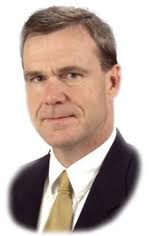
Dr. Terry Flotte at
Johns Hopkins
|
Terry Flotte ('79) started thinking about a career in scientific research in elementary school. A pivotal experience when he was 14 turned his attention to medicine.
- Terry's father was with him and his older brother Dave ('74) at a remote area near Slidell when Mr. Flotte suffered a heart attack that proved fatal.
- The trying visit to the emergency room planted the seed in Terry's mind of a career applying scientific knowledge to help people with health problems.
There's a whole world of things you can do within medicine. The medical sciences have outpaced our ability to apply it to human disease. I gravitated to the area of genetic diseases. We have the ability to harness all this genetic information for designing treatments very specific to the patient's condition.
I knew pretty well by 10th or 11th grade that I wanted to go into medicine. I vacillated back and forth - teacher, normal practice, research. Part of me wanted to be a physician dedicated to taking care of patients and being selfless. But part of me wanted to be in a lab doing research. I didn't realize one could do both.
Dr. Flotte began to focus his attention on research while doing post-doctoral work at Johns Hopkins University.
I wanted to get great training as a pediatrician and come back to New Orleans and set up my practice. But I encountered many individuals at Hopkins who are experts in clinical care for a condition and go back to their labs and work on the unknown questions about the disease.
- Terry was on the faculty at JHU for four years. He spent 75% of his time doing research and the rest in patient care. He taught in both settings, overseeing graduate students in the lab and teaching pediatric residents and fellows.
- In 1995, Flotte and his colleagues became the first to use the apparently harmless adeno-associated virus, or AAV, as a vehicle to deliver corrective genes to targeted sites in the body, including the damaged airways of adults with cystic fibrosis.
The following year, Terry joined the faculty of the University of Florida in Gainesville as Associate Director of the Powell Gene Therapy Center.
- He was also founding Director of the UF Genetics Institute, a cross-campus multidisciplinary unit encompassing gene therapy, human genetics, agricultural genetics, and comparative genomics.
I was not going to jump at just anything, but UF had a very advanced program in the study of one particular virus - a small DNA virus that infects by itself but causes no known disease and tends to stay with the patient a long time. UF had a track record on this. "We're going to put $6 million into gene therapy. We'd like you to come and co-direct this unit."
We expanded the clinical trials and began researching another genetic disease, Alpha 1 Antitipsin deficiency. Because we were successful, we attracted grant money. So they decided to broaden our scope and have us put together a campus-wide research institute.
- In 2002, Terry stepped down from these roles to accept the position of Chair of the Department of Pediatrics.
I was about to turn 40. I thought, "I'm too young to be a chairman. I'm still doing productive research work." Then I realized it was an opportunity to implement at Florida what I had experienced at Johns Hopkins. Bring molecular-based therapies into pediatrics.
- Dr. Flotte expanded the pediatric faculty from 75 to 125. The number of Fellows increased from 3 to 28.
|
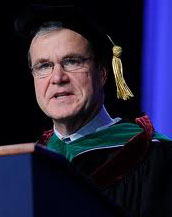
UMMS Dean Terry Flotte
|
After eleven years in Gainesville, Terry moved to Boston.
- He became the Dean of the University of Massachusetts Medical School. He also occupied the positions of executive deputy chancellor and provost.
- A 2011 news release announcing Terry's election to a five-year term on the Advisory Council of the American Society of Gene & Cell Therapy included these words.
An internationally known pioneer in human gene therapy, Dr. Flotte is currently investigating the use of gene therapy for genetic diseases that affect children, mainly cystic fibrosis. ... Since joining UMMS, Flotte has continued his pediatric practice while pursuing clinical trials and basic laboratory research to determine how to treat genetic disorders using vectors, or viruses modified to carry corrective genes. He is the author of more than 180 scholarly papers and his research has been funded by the National Institutes of Health, the Cystic Fibrosis Foundation and the Juvenile Diabetes Research Foundation.
|
Along the way, Terry dedicated countless hours to medical mission work.
- He was part of a team of two doctors and two nurses from Gainesville who flew to Thailand to assist survivors of the tsunami of December 2004.
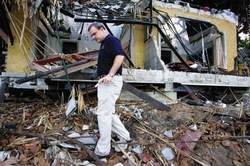
Terry Flotte in Thailand after the tsunami
- He also visited Haiti with a team of 15 UMass nurses and doctors following the 2010 earthquake.
My medical mission work resonated with the experiences I had at Brother Martin. The sense I got from the Brothers of the Sacred Heart, especially Brother Farrel, was that you show your love for God by showing your love for your fellow man, using your talents for the good of others. It was so ingrained in you it became visceral.
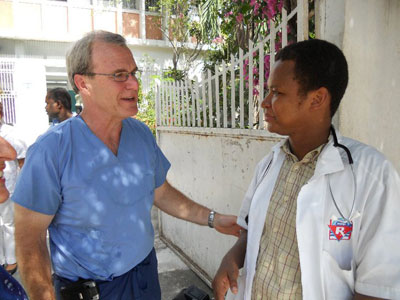
Dr. Flotte in Haiti
- Let's close with one of Terry's most poignant experiences in Haiti.
I worked at the St. Damien's Children's Hospital which was run by a Passionist priest-doctor, Father Rick Freschette, and Sister Judy Dohner since before the earthquake. The hospital takes in the sickest of the sick. Father Rick's morning mass is usually a requiem mass for the three or four babies who didn't make it through the night before. They bring in the families who are indigent and can't afford a funeral. Sometimes it's a mother dying in childbirth. They sing and lament and have a more outward display of grief than we often do.
One of the doctors and I worked on a baby that had severe bacterial sepsis - a blood infection. Sister Judy said, "You guys better jump in here. The resident physicians aren't making any headway." At mass the next morning there were no bodies. So we thought, "The baby made it through the night!" It was one of the more joyful masses we attended there. But when we went back to the ICU, we learned that the baby had passed away in the wee hours of the morning - too late to prepare the body for mass.
|
|