 |
CRIMSON SHIELD THE ONLINE MAGAZINE OF BROTHER MARTIN HIGH SCHOOL |
|
| January 2013 Published Monthly September through May |
||
From Band to Bench
|
Judge Kurt Engelhardt ('78) didn't plan on a career in the law until late in his undergraduate years.
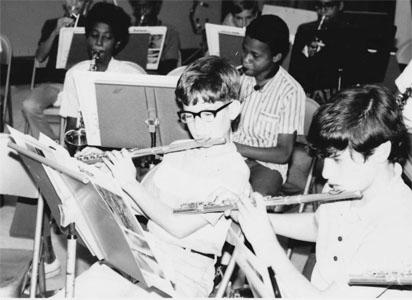 Kurt Engelhardt (glasses) at Band Camp (photo courtesy of Arthur Hardy) |
|
- Kurt remembers Brother Warren, his eighth-grade religion teacher, and the tandem of Brother Rene and Brother Christopher, who taught reading. Kurt got an early introduction to what was expected of Crusaders when Brother Rene chewed out the smartest student in the class for smiling. Everyone knew this man was serious.
- Other teachers he remembers fondly are Brother Leo, Guy Nelson, Brother Maurus, Jack Schommer, Nick Lagatutta, Brother Francis David, Brother Carl, Brother Farrell (great masses in the Resource Center), Marty Hurley, as well as his Geometry teacher.
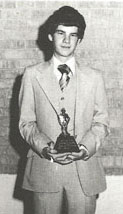
- Kurt served on the newspaper staff, the Key Club, and the Student Council. His Brother Martin career culminated in a Golden Crusader award.
I did just the opposite of many grads who started at LSU and returned home to UNO after a year or two.
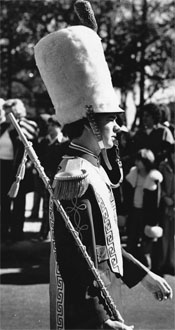
- Kurt played an odd pair of instruments in the Tiger Band for one year. LSU traveled to Notre Dame for the second game of the 1981 season. The entire band made the trip, during which one of the trombone players broke his ankle.
- So the band director, Frank Wickes, asked Kurt to carry a trombone during the halftime shows the rest of the season while still playing piccolo pregame and in the stands.
- Not content to just hold the instrument while marching, Kurt got rudimentary lessons from the trombone leader and, by the end of the season, estimates he played 80% of the notes during the halftime show.
- My father suggested the law as a career because I liked to argue.
- After just one week, when several had already dropped out, he knew he had made the right decision.
- After graduation in 1985, he served two years as a clerk for Judge Charles Grisbaum (SA '55) of the Louisiana Fifth Circuit Court of Appeals.
- Kurt then joined a mid-size New Orleans law firm where he handled mostly commercial litigation. In law school, he didn't think he'd be a litigator, but once he actually got into courtrooms, he changed his mind, in part because he liked the competitive aspect of cases.
During this period, he became civically active, which would prove to be a crucial step on his path to becoming a judge.
- He joined the Alliance for Good Government and became involved in Republican political campaigns, including David Vitter's first run for the state legislature.
- Kurt was appointed by the Governor to serve a four year term on the State Judiciary Committee, which hears ethical complaints made against state judges. He was elected Chair of the Commission his last year. That experience piqued his interest in what judges do on a day-to-day basis.
In 1999, an opening occurred in a judgeship in Jefferson Parish.
- But Vitter, who entered the U.S. House of Representatives that year, urged Kurt to wait and see what would happen in 2000. The Governor of Texas is running for president.
- Kurt worked for George W. Bush's campaign and attended his inauguration.
- When a new administration takes over in Washington, they compile lists of candidates for the multitude of government positions, including judgeships.
- Then-Congressman Vitter put Kurt's name on the Louisiana Congressional delegation's list with the support of both Democratic senators, John Breaux and Mary Landrieu, and Billy Tauzin, the ranking Republican representative.
- As a result, Kurt went to the White House in April 2001 for an interview with three staff members, who asked questions about his judicial philosophy. They also asked, Is there anything in your past that might embarrass the president if he nominates you? Kurt then met for 40 minutes with the White House Counsel, Alberto Gonzalez (who would become Attorney General in President Bush's second term). Kurt thought he was ready for any question but was taken aback when Gonzalez asked, What would your wife say about you?
- He also had to fill out a stack of questionnaires and forms. The FBI did the customary background check on him. They asked him for every address where he had lived.
My neighbors asked me if I was in trouble since the FBI had called on them. They even interviewed my college roommates.
In August 2001, the president nominated Kurt for a vacant position on the U.S. District Court for the Eastern District of Louisiana.
- He was immediately sent more questionnaires by the Senate Judiciary Committee, which would hold a hearing before sending his nomination to the full Senate for approval.
- A Times-Picayune reporter requested an interview with the nominee. So Kurt met with her in his law office on the morning of 9/11.
I saw on the TV that a plane had crashed into the Trade Center but thought it was just an accident. When I turned on the TV after the interview, I learned of the terrorist attacks. Her article never ran in the Picayune.
- He expected his confirmation would be delayed because of the attacks, but the opposite took place for two reasons. First, bipartisanship flourished during the wave of patriotism and, secondly, the government was anxious to show that it was functioning normally despite the disruptions.
- So he flew to Washington shortly after 9/11 for the hearing. First, several members of the Senate staff prepped him by hitting him with questions he might face from the Committee. They instructed him to be more vague and offer fewer details in his answers.
- As it turned out, the members of the committee gave him only "softball" questions, in large part because both Democratic senators from Louisiana testified on his behalf along with Representative Vitter.
- So Kurt was confirmed on December 11, 2001, and took the oath two days later.
|
|
Judge Engelhardt's longest and toughest case has been the Danziger Bridge shootings, which was assigned to him by random allotment.
The case is the prime example of the responsibility each judge faces.
Judge Engelhardt is glad to be in the Federal court system rather than presiding in a state court.
|
